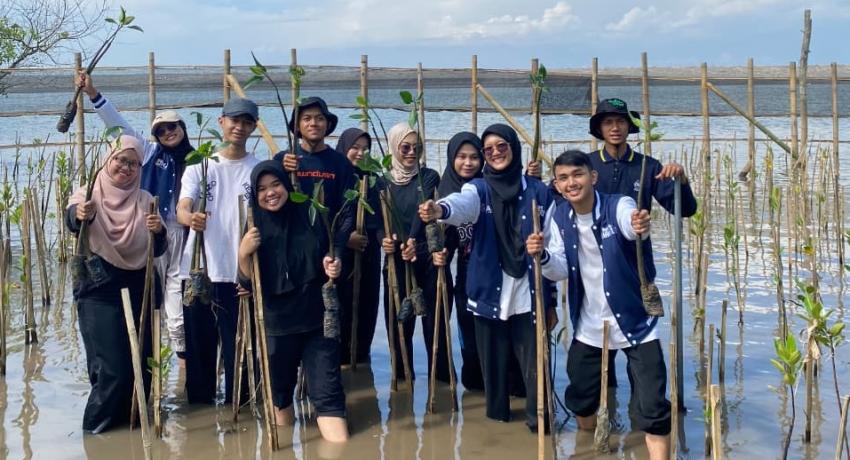



A group of fifth-batch Bintang Mandiri Scholarship recipients from Bank Mandiri recently carried out a social project titled Green Coast Baros in the Baros Mangrove Forest area, located in Tirtohargo, Kretek, Bantul, Special Region of Yogyakarta. The initiative was led by Melisa Sekarlina Putri Dayani, a student of Biology Education at Universitas Negeri Yogyakarta.
The social project represents the students’ contribution to preserving coastal ecosystems while also promoting community economic empowerment through collaboration with various stakeholders, including mangrove area managers, local government, and small and medium enterprises (SMEs).
The project team consisted of five awardees from different universities across Indonesia: Melisa Sekarlina Putri Dayani (Biology Education), A. Soffi (Management), and Annisa Nur Rahma (Educational Technology) from Universitas Negeri Yogyakarta; Arip Fathurahman from Universitas Mataram; and Ikhwanul Huda from Universitas Muhammadiyah Sumatera Utara. Melisa explained that the Green Coast Baros project not only focuses on conservation activities but also emphasizes a collaborative approach involving multiple stakeholders.
“This initiative is designed as a collaborative movement between students, local communities, mangrove area managers, and the local government. We aim to create a program that not only contributes to environmental conservation but also provides tangible benefits for the surrounding community,” she said.
One of the main activities of the project was planting mangrove seedlings along the Baros coastal area as part of ecosystem rehabilitation efforts. Mangroves play a vital role in maintaining shoreline stability, reducing coastal erosion, and providing habitat for various marine species. A. Soffi, a Management student involved in the project, added that the initiative also aims to strengthen local economic potential through partnerships with SMEs in the Baros area.
“We see strong local economic potential in this area. Therefore, we collaborated with local SMEs by conducting training on salted egg production, enabling residents to develop additional skills that can be turned into productive businesses,” said Soffi.
In addition, the program included educational sessions highlighting the importance of mangrove ecosystems for sustainable coastal environments. The sessions covered ecological functions of mangroves as well as the utilization of driftwood waste commonly found along the coast.
Annisa Nur Rahma, an Educational Technology student involved in the project, emphasized the importance of the educational approach in raising environmental awareness among the community. “We want this initiative to go beyond planting activities by fostering environmental awareness. Through education, we hope the community will better understand the importance of preserving mangroves and sustainably utilizing coastal resources,” she explained.
The Green Coast Baros project was also carried out in collaboration with the Baros mangrove area management and supported by the Bantul Regency Tourism Office, which continues to promote the area as an ecotourism destination.
A representative of the Baros mangrove management welcomed the initiative, noting that collaboration between students, government, and the community is essential for maintaining the sustainability of the mangrove area while enhancing local tourism and economic potential.
“We highly appreciate the students’ initiative. Collaboration like this is crucial in preserving the sustainability of the Baros mangrove area while supporting community empowerment through environmentally based economic and tourism activities,” the representative stated.
By integrating conservation efforts, environmental education, and community economic empowerment, the Green Coast Baros project contributes to the achievement of the Sustainable Development Goals (SDGs), particularly SDG 13 (Climate Action), SDG 14 (Life Below Water), SDG 15 (Life on Land), SDG 8 (Decent Work and Economic Growth), and SDG 4 (Quality Education).