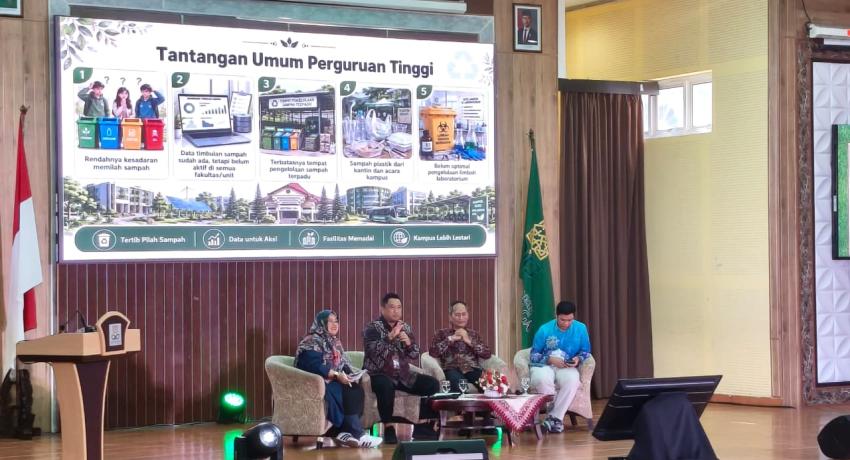



The commitment of higher education institutions to advancing green campuses was reinforced at the UI GreenMetric Workshop for Islamic Higher Education Institutions (PTKI) 2026, held at UIN Sunan Kalijaga Yogyakarta. Carrying the theme “Integrating UI GreenMetric to Realize an Ecotheology-Based Green Campus,” the forum served as a platform for universities to share best practices in sustainable environmental governance.
At the event, Universitas Negeri Yogyakarta (UNY) Vice Rector for Cooperation and Information Systems, Prof. Soni Nopembri, presented UNY’s Circular Approach: Smart Integration and Community Empowerment in Sustainable Waste Management. The presentation highlighted how UNY has developed a waste management system that goes beyond technology by actively involving academic communities and society.
“Waste management in higher education can no longer be seen as merely a technical issue. It must become part of a broader transformation of campus culture. Through a circular approach, we promote a shift in perspective—viewing waste as a resource that can be managed productively and sustainably,” Prof. Soni stated on Saturday (May 1, 2026).
He explained that effective waste management requires the integration of data, policy, and community empowerment. UNY has been working to reduce waste volume at the source through sorting, processing, and reuse strategies.
“Technology is an important instrument, but the success of environmental management ultimately depends on human involvement. Therefore, we position the academic community as the main actor in a sustainable waste management ecosystem,” he added. The presentation also illustrated the growing dynamics of waste production on campus, driven by increasing activities in education, research, and community service—highlighting the need for adaptive and collaborative strategies.
UNY’s approach aligns closely with the concept of ecotheology, the central theme of the workshop, which frames ecological responsibility as an ethical and spiritual value. In this context, universities are not only centers of learning but also agents of social change in promoting environmental sustainability.
“Campuses must become living laboratories for sustainability practices. When ecological values become part of academic culture, the impact extends beyond campus and into society,” he emphasized.
UNY’s contribution is in line with the Sustainable Development Goals (SDGs), particularly SDG 12 (Responsible Consumption and Production), SDG 13 (Climate Action), and SDG 17 (Partnerships for the Goals).
Participants from various Islamic higher education institutions across Indonesia responded positively to the presentation. The circular waste management model introduced by UNY was considered a relevant and replicable approach for other campuses aiming to strengthen sustainable environmental governance.
Through this forum, universities are encouraged not only to achieve sustainability indicators but also to build collective awareness of ecological responsibility. With concrete initiatives like those implemented by UNY, the transformation toward green campuses is becoming increasingly tangible and impactful.