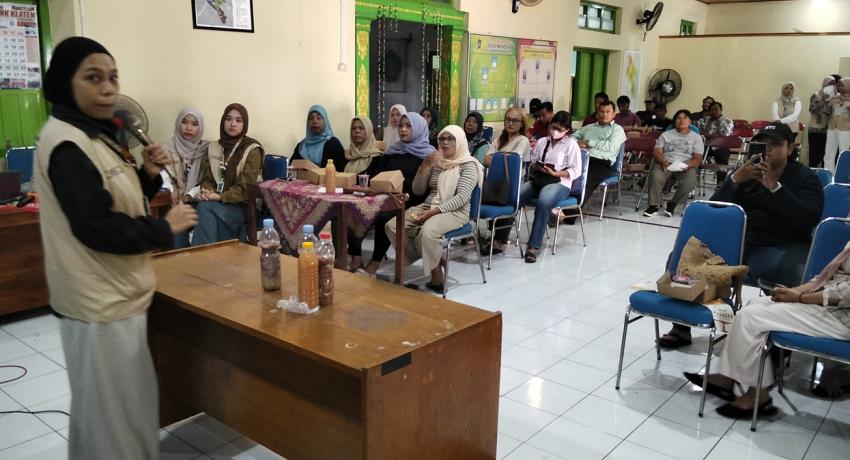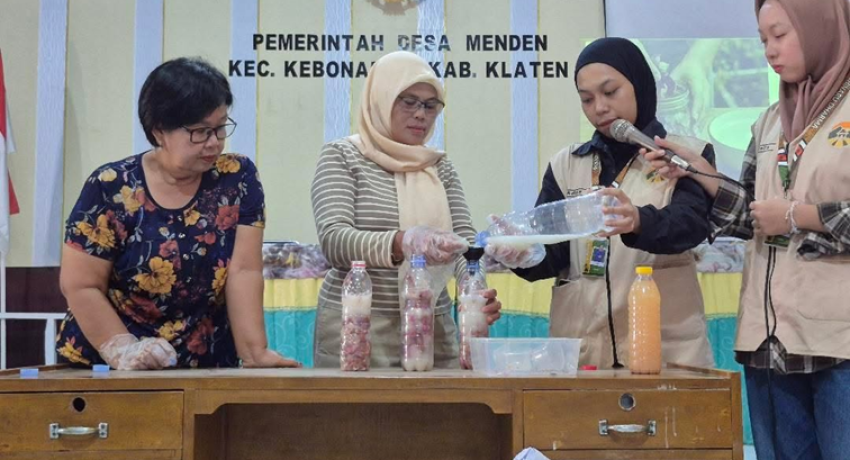




Students from Universitas Negeri Yogyakarta (UNY) participating in the Off-Campus Learning Program (PLK) have demonstrated innovative thinking through a simple yet impactful initiative in Menden Village, Kebonarum, Klaten. The team successfully transformed shallot skin waste into liquid organic fertilizer (POC), offering an environmentally friendly and practical solution for local communities.
The initiative was inspired by the abundance of household waste in the form of onion skins, which are typically discarded. By applying practical scientific approaches, the students introduced a method to convert organic waste into a valuable product for household agriculture, supporting the Sustainable Development Goals (SDGs), particularly SDG 12 (Responsible Consumption and Production).
Adita Ananta Putri, a Chemistry student from the Faculty of Mathematics and Natural Sciences at UNY and resource person for the program, explained that onion skins contain compounds beneficial for plant growth. “Onion skins contain substances that can stimulate root development, improve soil fertility, and reduce dependence on chemical fertilizers,” she said.
The process of producing the liquid organic fertilizer is simple and accessible for the community. The main ingredients include onion skins, rice washing water (first rinse), and palm sugar. These materials are fermented in a closed container for approximately seven days until a solution with a distinct fermentation aroma is produced.
Fauzan Nurul Huda, head of the PLK team in Menden Village, emphasized that the program focuses not only on product innovation but also on community education. “We aim to encourage residents to be more aware of household waste management. Through this simple method, waste that previously had no value can be transformed into something useful and potentially reduce agricultural costs,” he explained.
The initiative received positive responses from local residents, who actively participated in the training and practiced making the fertilizer themselves. In addition to being easy to produce, the fertilizer has proven effective in enhancing the growth of vegetables and ornamental plants.
The Menden Village PLK team consists of ten students: Alia Lailatul Udhiyah, Fauzan Galih Ramadan, Fauzan Nurul Huda, Iffah Nur Fauziyyah, Adita Ananta Putri, Berlian Aurel Hartoto, Adelia Revariana Putrinova, Mumtaz Alifiyana Putri, Hanna Anggita Martania, and Bayu Rizqianto Febri Saputra. This interdisciplinary collaboration strengthens the implementation of community-based empowerment programs.
Beyond its economic benefits, the initiative also contributes to SDG 13 (Climate Action) by reducing organic waste and SDG 15 (Life on Land) by promoting environmentally friendly fertilizers. Transforming kitchen waste into liquid organic fertilizer represents a small step with significant impact in fostering sustainable lifestyles within communities.
Through this program, UNY PLK students not only apply their academic knowledge but also deliver practical solutions to rural communities. The initiative is expected to be further developed and replicated in other areas as part of a broader community-based waste management movement.
The fertilizer was introduced to the public at the Menden Village Hall on Sunday (May 3, 2026), attended by more than 50 enthusiastic residents. One participant, Sri Yuliani, expressed her appreciation for the program, noting that she had just learned about the benefits of onion skin waste, which she had previously considered useless. “I will definitely try this at home,” she said.