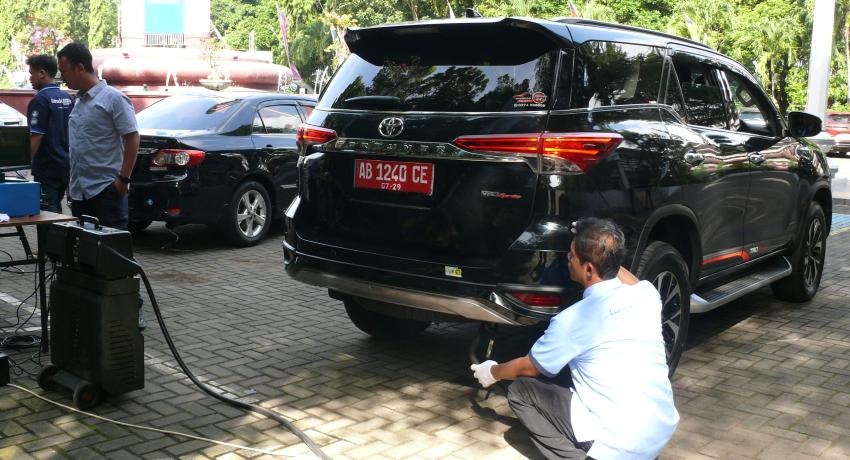



Yogyakarta – Universitas Negeri Yogyakarta (UNY) conducted an emissions testing program for private and official vehicles at the Rectorate parking area on Tuesday, May 26, 2026, as part of its commitment to promoting a healthier and more sustainable campus environment.
According to Indun Probo Utami, M.Pd., Head of Facilities, Infrastructure, and Household Affairs at UNY, the initiative was carried out to comply with Government Regulation No. 22 of 2021 on Environmental Protection and Management.
"In addition to fulfilling regulatory requirements, this program aims to help maintain air quality in Yogyakarta while increasing public awareness of the importance of motor vehicle emissions testing," she said.
The program targeted the inspection of more than 30 gasoline- and diesel-powered vehicles, including four UNY buses.
The emissions tests were conducted using equipment provided by the Automotive Engineering Laboratory of the UNY Faculty of Engineering. Idham Ahmad Shohibul, a student of Automotive Engineering Education who participated in the testing process, explained that vehicles pass the emissions test when their exhaust emissions comply with the maximum limits established by the government under Government Regulation No. 22 of 2021.
For gasoline-powered vehicles (spark-ignition engines), the acceptable emission levels vary according to the vehicle's year of manufacture. Passenger cars manufactured before 2007 must not exceed 4% carbon monoxide (CO) and 1,000 ppm hydrocarbons (HC). Vehicles produced between 2007 and 2018 are limited to 1% CO and 150 ppm HC, while those manufactured after 2018 must meet stricter standards of 0.5% CO and 100 ppm HC. Similar standards apply to gasoline-powered commercial vehicles, with slight differences in the allowable HC levels. Testing is conducted while the engine is idling.
For diesel-powered vehicles (compression-ignition engines), compliance is determined by measuring smoke opacity during free acceleration. Vehicles with a gross vehicle weight of 3.5 tonnes or less must meet maximum opacity limits of 65% HSU for vehicles manufactured before 2010, 40% HSU for those produced between 2010 and 2021, and 30% HSU for vehicles manufactured after 2021. Heavier diesel vehicles are subject to similar standards, with a maximum of 35% HSU for vehicles produced after 2021. Vehicles pass the test if their measured opacity remains below the applicable threshold.
Eko Siswanto, a laboratory technician from the Automotive Engineering Laboratory, explained that several factors may cause a vehicle to fail the emissions test, including the use of inappropriate fuel, problems with the combustion system, or defects in the exhaust system.
"To ensure vehicles meet the required emission standards, owners should perform regular maintenance, including routine oil and filter replacement," he advised.
Vehicles that successfully passed the emissions inspection received an official emissions compliance sticker, which was affixed to the rear windshield.
The implementation of this emissions testing program demonstrates UNY's commitment to supporting environmental sustainability and reducing air pollution. The initiative contributes to the United Nations Sustainable Development Goals (SDGs), particularly SDG 3 (Good Health and Well-being) by promoting cleaner air, SDG 11 (Sustainable Cities and Communities) by encouraging environmentally responsible transportation, and SDG 13 (Climate Action) through efforts to reduce vehicle emissions and raise public awareness of sustainable mobility.