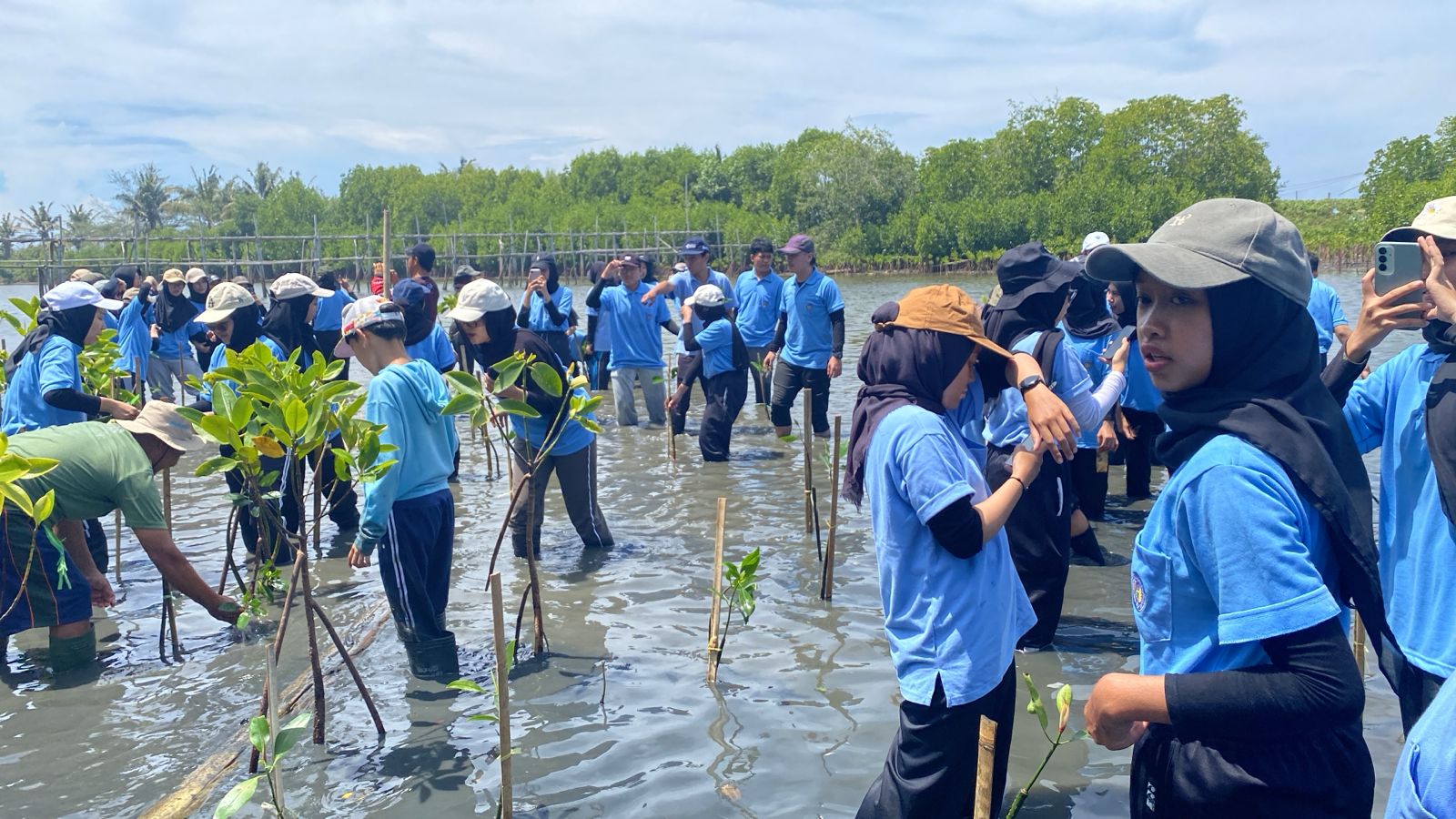




UNY once again reaffirmed its commitment to environmental sustainability by conducting a mangrove planting activity along the coastal area of Pasir Mendit Beach, Jangkaran, Temon, Kulon Progo, on Sunday (12/10/25). The initiative forms part of UNY’s contribution to the Sustainable Development Goals (SDGs)—particularly SDG 13 (Climate Action), SDG 14 (Life Below Water), and SDG 15 (Life on Land)—while also strengthening the university’s performance in the UI GreenMetric (UIGM) ranking, which assesses universities based on environmental sustainability practices.
The activity began with mangrove planting carried out by 90 UNY students from various faculties, including several international students. This was followed by a beach clean-up, during which plastic waste, household trash, and other inorganic materials were collected and sorted. The effort marked an initial step toward creating a cleaner coastal ecosystem ready to support new mangrove growth.
In his remarks, UNY Vice Rector for Cooperation and Information Systems, Prof. Soni Nopembri, stated that the activity provided students with hands-on learning opportunities about marine environments and mangrove ecosystems. “This mangrove planting initiative supports sustainable coastal and marine ecosystems,” he said.
The Chair of Wana Tirta Pasir Mendit Beach Management, Warso, welcomed the UNY-led initiative. “Mangroves are not just ordinary plants; they play a crucial role in preventing sedimentation and mitigating disasters by absorbing large amounts of carbon,” he explained. Warso’s efforts to develop the mangrove tourism area began in 2009 with the planting of 50,000 mangrove trees in collaboration with LPPSP Semarang. The site officially opened as a tourist destination in 2016 and has since gained widespread attention.
The activity coordinator, Isti Yunita, Ph.D., emphasized that the initiative was more than a symbolic gesture, describing it as part of the integration of UNY’s sustainable campus programs with direct field-based action. “Mangroves play a vital role in preventing coastal abrasion, supporting biodiversity, and contributing significantly to climate change mitigation. This planting activity supports multiple SDG targets while also enhancing UNY’s sustainability score within the UI GreenMetric system,” she said.
According to Isti, coastal environmental conservation efforts—such as cleaning plastic and inorganic waste from shorelines—aim to reduce marine pollution and maintain healthy coastal ecosystems. Mangrove planting helps prevent erosion, stabilize sediments, and provide critical habitats for various coastal species.
The activity also contributes to climate change mitigation. Mangroves have a much higher carbon absorption capacity than terrestrial forests. By planting mangroves, the university actively contributes to reducing greenhouse gas emissions and strengthening coastal resilience against the impacts of climate change. The planting location was selected based on data identifying areas vulnerable to abrasion and declining coastal ecosystem quality.
The program involved local community elements, including Wana Tirta and the Kulon Progo Environmental Foundation, which participated in planting and field-based education. This collaboration reinforced participatory and inclusive principles aligned with UI GreenMetric indicators, such as environmental education, land use, energy, waste management, and environmentally friendly transportation.
One of the participants, Wina, a student from the Biology Education Study Program, Faculty of Mathematics and Natural Sciences (FMIPA) UNY, expressed her pride in being directly involved. “I learned how to plant mangroves properly, including understanding the trees themselves,” she said.
The activity forms part of UNY’s community service and environmental conservation programs. Looking ahead, UNY plans to initiate sea turtle conservation efforts and develop a coastal-based educational area as an open natural laboratory. “We want UNY to excel not only academically, but also to actively contribute to achieving the SDGs and becoming an environmentally friendly campus in line with UI GreenMetric indicators,” Isti Yunita concluded.
Through this concrete action, UNY demonstrates its role as a university that not only educates, but also actively engages with communities in building a sustainable future.