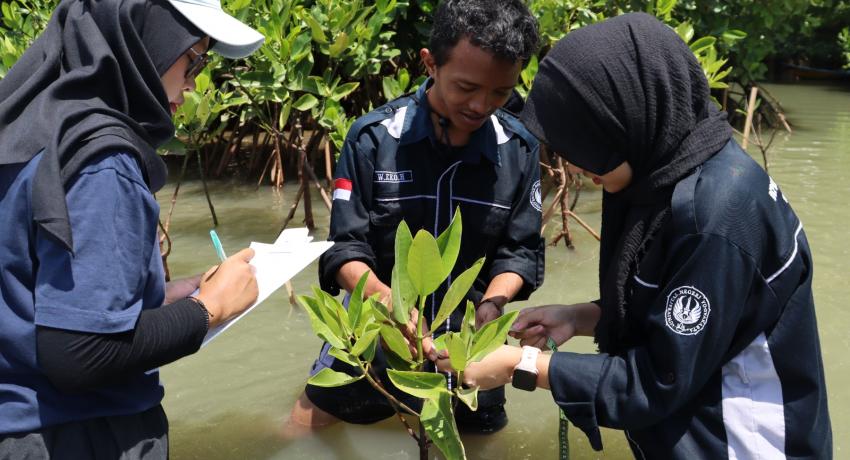




Students of the Biology Education Study Program, Faculty of Mathematics and Natural Sciences (FMIPA), Universitas Negeri Yogyakarta (UNY) conducted monitoring of mangrove growth and species identification along the coastal area of Pasir Mendit Beach, Jangkaran Village, Temon Sub-district, Kulon Progo Regency, recently. The activity was a follow-up to the planting of 100 mangrove seedlings carried out last October and also served as a field-based learning experience for students to directly observe mangrove biodiversity.
The monitoring activity involved five representatives of Biology Education students from FMIPA UNY and was supervised by the lecturer of the Aquatic Biology course. The supervising lecturer actively participated in observing and evaluating the growth of the planted mangroves. Monitoring activities included measuring stem height and leaf size, as well as recording the number of surviving mangrove individuals as indicators of ecosystem condition and the success of mangrove rehabilitation in the area.
In addition to growth monitoring, students also received hands-on learning in identifying mangrove species found at Pasir Mendit Beach. Species identification is an essential competence for Biology Education students, as each mangrove species has distinct morphological characteristics, structures, and ecological functions that influence coastal environments in different ways. Through this activity, students were trained to conduct direct field observations to distinguish mangrove species based on visible morphological traits.
The Aquatic Biology course lecturer, Rio Christy Handziko, emphasized that biology learning should not be limited to classroom instruction but strengthened through field activities. According to him, mangrove ecosystems are a crucial subject in aquatic biology studies, particularly in coastal regions. “Through mangrove species identification and post-planting growth monitoring, students not only learn morphological characteristics from references but also practice direct identification in nature,” he explained.
Mangrove ecosystems play a strategic role in maintaining coastal stability. Mangroves function as natural barriers against abrasion and tidal waves, as well as habitats, shelters, and spawning grounds for various aquatic organisms such as fish, shrimp, crabs, and other marine life. Through this monitoring activity, students are expected to better understand the conditions and dynamics of mangrove growth as part of environmental conservation efforts, while strengthening their understanding of mangrove biodiversity through direct field-based learning.
This monitoring and field learning activity aligns with the Sustainable Development Goals (SDGs), particularly SDG 14 (Life Below Water), SDG 4 (Quality Education), and SDG 13 (Climate Action).