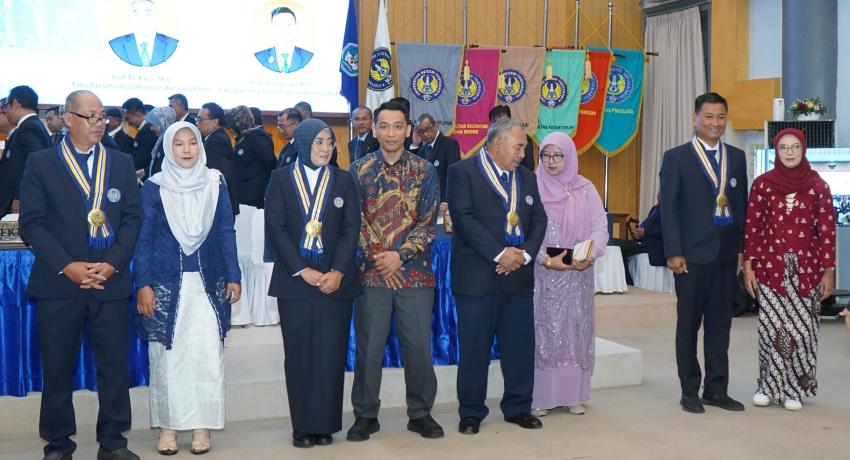




Universitas Negeri Yogyakarta (UNY) once again reaffirmed its role as a higher education institution that promotes impactful innovation through the inauguration of four professors on Wednesday (13/5/2026) at the Main Meeting Hall of the Rectorate Building. More than just an academic ceremony, the inauguration presented major ideas about Indonesia’s future, ranging from environmentally friendly material technology and sustainable energy to sports development and character education for younger generations.
The four academics inaugurated were Prof. Dr. Tiwan, M.T. from the Faculty of Engineering, Prof. Dr. Cahyorini Kusumawardani, M.Si. from the Faculty of Mathematics and Natural Sciences, Prof. Dr. Fauzi, M.Si. from the Faculty of Sports Sciences and Health, and Prof. Dr. Sujarwo, M.Or. from the Faculty of Sports Sciences and Health.
The Rector of UNY, Prof. Sumaryanto, expressed his appreciation for the highest academic achievements attained by the newly inaugurated professors. According to him, the inauguration of professors is an important step in strengthening UNY’s academic capacity to provide solutions to various national challenges. “Congratulations on the inauguration of our professors today. In the future, lecturers are expected to propose for professorship by the age of 50. Therefore, the ideal planning is for lecturers to obtain their doctoral degrees and functional lecturer positions by the age of 35,” stated the Rector.
The Rector also emphasized that UNY continues to strengthen its academic ecosystem through the acceleration of lecturers’ career development. Currently, the university is encouraging more lecturers to achieve the highest academic rank in order to reinforce the culture of research and innovation on campus.
One of the strategic ideas was presented by Prof. Dr. Tiwan, M.T., Professor in the field of Materials Technology at the Faculty of Engineering. In his speech entitled “Developments, Challenges, and Alternative Solutions of Aluminum Material Technology in the Era of Sustainable Manufacturing Industry,” he highlighted the importance of aluminum as a strategic material to support more environmentally friendly modern industries. Aluminum is considered advantageous due to its lightweight properties, corrosion resistance, and recyclability, which contribute to energy efficiency and carbon emission reduction in the manufacturing sector.
Meanwhile, Prof. Dr. Cahyorini Kusumawardani, M.Si., Professor in the field of Solid-State Inorganic Chemistry at the Faculty of Mathematics and Natural Sciences, highlighted the importance of material innovation in addressing global energy and environmental challenges. Through her speech entitled “Modification of Functional Inorganic Materials in Realizing Sustainable Energy and Environment,” she explained the development of semiconductor materials such as titanium dioxide (TiO₂) to support solar energy, photocatalysis, and environmental purification.
In the field of sports, Prof. Dr. Fauzi, M.Si., Professor in the field of Sports Coaching Education Evaluation at the Faculty of Sports Sciences and Health, emphasized that sports have strategic contributions to human development. In his speech entitled “Evaluation of Sports Coaching Education from the Perspective of Sustainable Development Goals (SDGs),” he stressed that sports are not only related to achievement but also to health, education, equality, and economic growth.
Meanwhile, Prof. Dr. Sujarwo, M.Or., Professor in the field of Volleyball Learning at the Faculty of Sports Sciences and Health, highlighted the importance of sports as a medium for character building. Through his speech entitled “Volleyball Learning to Habituate Positive Character Values in Students,” he explained that sports education can instill discipline, responsibility, teamwork, and respect for others.
The inauguration of these four professors demonstrates how UNY continues to strengthen its contribution to sustainable development through technological innovation, environmentally friendly energy, sports improvement, and character education. This also supports the achievement of SDG 4 (Quality Education), SDG 7 (Affordable and Clean Energy), SDG 9 (Industry, Innovation, and Infrastructure), and SDG 3 (Good Health and Well-Being) in building an advanced and competitive society.