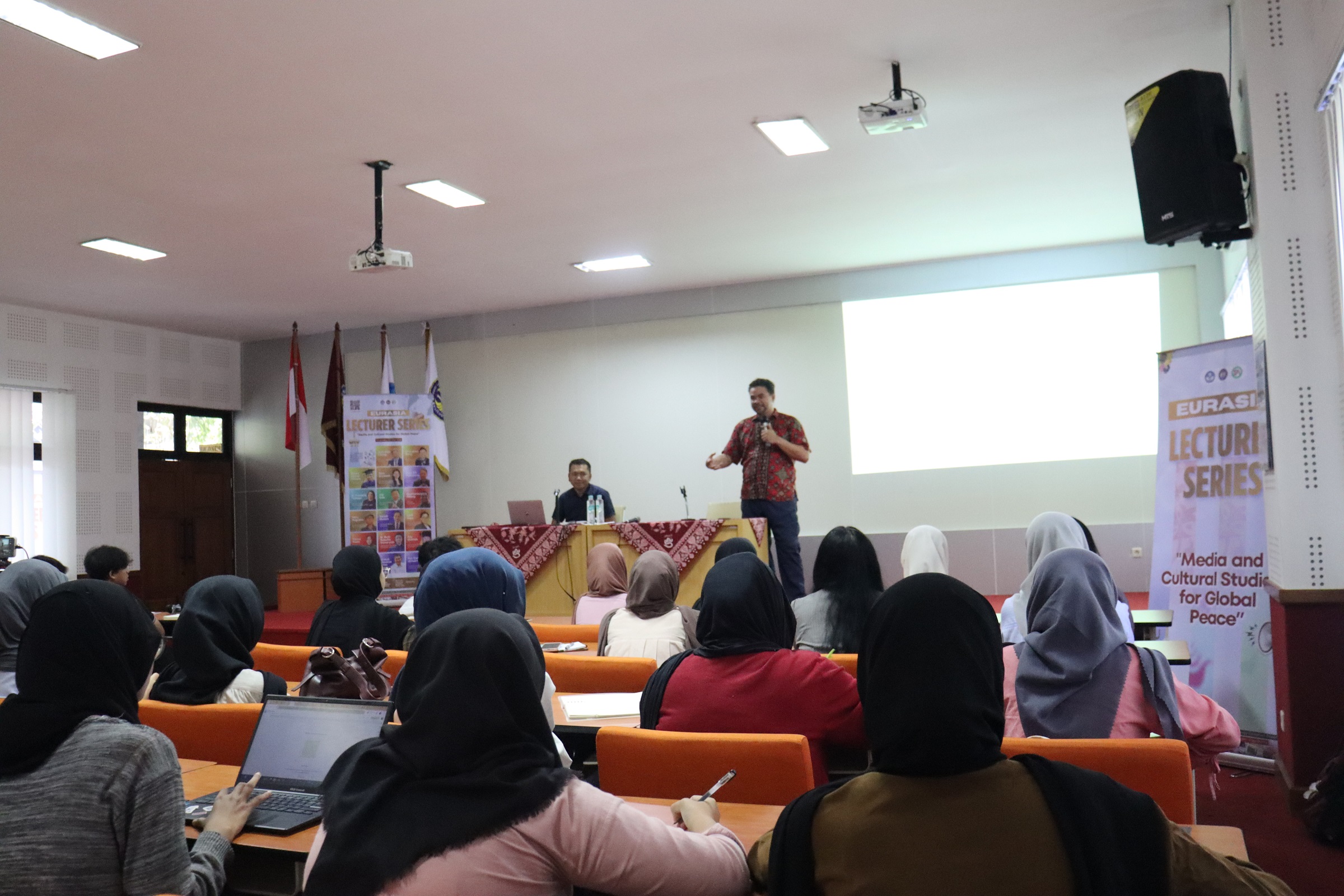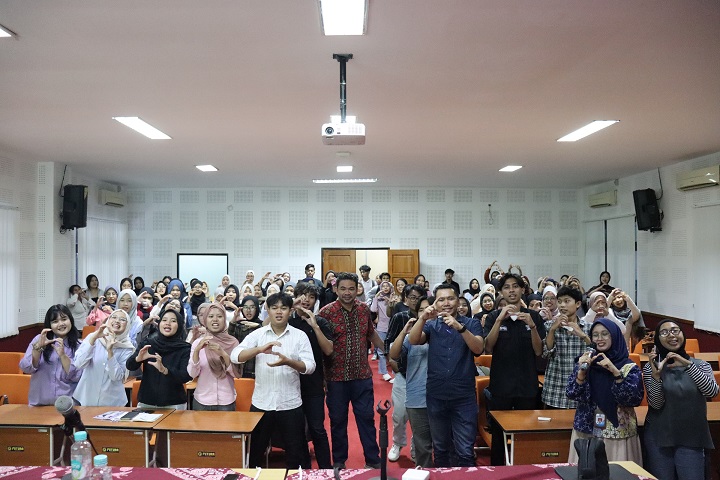




The Faculty of Social and Political Sciences (FISIP) of Universitas Negeri Yogyakarta (UNY), through the Eurasia Lecturer Series Vol. 2 Episode 4, held a philosophical discussion on the relationship between knowledge and power from the perspective of French philosopher Michel Foucault. The event featured Reza A.A. Wattimena from Rumah Filsafat and took place at the FISIP UNY Postgraduate Hall.
In his presentation, Reza opened the discussion with simple questions often encountered in everyday life, such as why the right hand is considered more polite than the left, why men wear trousers while women wear skirts, and why teachers stand at the front of the classroom while students sit in rows behind them. These questions illustrate that many things considered right or wrong in society are, in fact, social constructions accepted as normal.
Reza explained that Michel Foucault’s ideas on the relationship between knowledge and power can be traced through two of his major works, The Archaeology of Knowledge and Power/Knowledge. These works show that knowledge is never neutral, but is always connected to social practices and power relations. Knowledge plays a role in shaping ways of thinking, defining truth, and regulating individual behavior in society.
He further explained that the human body is never entirely free from the influence of knowledge. Knowledge helps discipline the body through various social institutions, including educational institutions. Through rules, practices, and mechanisms within them, education becomes a space where individual behavior and discipline are formed.
The discussion also highlighted that power does not exist only within major institutions such as the state, but is also present in small everyday practices. In the context of education in Indonesia, this can be seen in the use of school uniforms, marching activities, and examination-based evaluation systems, which indirectly shape students’ bodily discipline and behavior.
Beyond education, the relationship between knowledge and power is also found in the media through the framing of information. Media play a role in influencing how society understands an event. Phenomena such as cancel culture also demonstrate how society can collectively determine the boundaries of truth, morality, and social identity accepted in the public sphere.
Through this activity, participants were invited to understand that knowledge does not merely function to explain reality, but is also part of a social mechanism that shapes ways of thinking, behavior, and power structures in society. The event is expected to encourage participants to think critically and become independent individuals in understanding various constructions of knowledge that develop within society.