


The end of 2025 left deep scars in several parts of Indonesia. Floods struck a number of provinces on Sumatra Island, including North Sumatra, West Sumatra, and Aceh. In Aceh Tamiang Regency, the floodwaters did not only inundate houses and public facilities, but also disrupted the rhythm of community life. Village fields fell silent, learning spaces came to a halt, and places of worship lost their usual activities.
In response to the situation, Universitas Negeri Yogyakarta (UNY) sent 100 students through the Humanitarian Community Service Program (KKN), in collaboration with Universitas Samudra, Universitas Pembangunan Nasional Veteran Jakarta, and Universitas Sultan Ageng Tirtayasa. The selected students had gone through a rigorous selection process, including administrative screening, medical examinations, physical tests, psychological assessments, and interviews. Of the 100 students, seven came from the Department of Sociology Education, including Rajif Muzamil Rohman.
For Rajif and his team, the impact of the flood was not only about damaged buildings, but also about the disruption of social routines that had long been part of residents’ daily lives. From a sociological perspective, disasters often damage social spaces — spaces where interaction, habits, and solidarity are formed. When children no longer play on the field, when Qur’an learning activities at the TPQ stop, and when the mosque is no longer lively, what disappears is not merely activity, but the pulse of collective life.
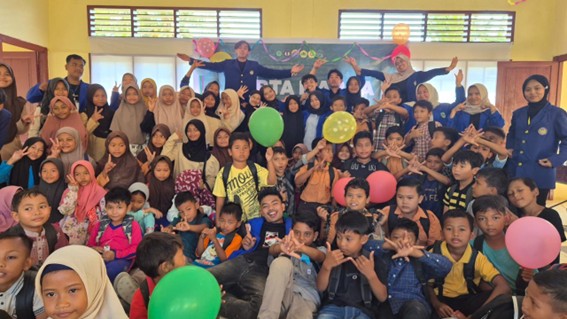
During their time in Sapta Marga Village, Manyak Payed District, Aceh Tamiang Regency, Rajif and his group worked to revive these activities. They were involved in teaching at schools to support the learning process that had been disrupted. In the afternoon, they held additional tutoring sessions for students and assisted learning activities at the TPQ so that children could return to the habit of reading the Qur’an. The mosque, which had also been affected by the flood, was cleaned together with residents so it could once again be used comfortably. Even simple activities such as playing with children in the afternoon became an important part of psychosocial recovery.
Football became a small yet meaningful symbol. The field, once quiet, gradually filled again with laughter. The ball was kicked once more, and children ran freely.
“Thank you to the brothers and sisters, because with you here, the children can play football again and laugh again,” said Gilang, a local resident.
The simple statement showed that recovery is not always measured by physical reconstruction, but also by the return of smiles and everyday routines.
In addition to educational activities and child mentoring, the students were also involved in assisting micro, small, and medium enterprises (MSMEs) to help residents recover economically, carrying out greening programs as a reminder of the importance of environmental care, organizing group exercise activities to support health, and assisting with administrative data at the district level.
In a dynamic recovery situation, they also helped clean public facilities, distribute donations, attend takziah as a form of social empathy, and assist in checking locations for the construction of temporary shelters. These various activities are in line with the commitment to the Sustainable Development Goals (SDGs), particularly in the areas of quality education, poverty reduction, good health, and the strengthening of sustainable communities. At the national level, the initiative also aligns with the development vision of Asta Cita, which emphasizes human resource development, village-based development, and the strengthening of community social resilience.
All of these efforts were not merely a list of activities, but part of an attempt to reopen social spaces that had been disrupted by disaster. Amid a structural recovery process that requires a long time, small initiatives involving direct interaction with the community serve as a reminder that togetherness is the main foundation for rebuilding life after a disaster.
The Humanitarian KKN program in Aceh Tamiang shows that recovery is not only about rebuilding homes and infrastructure, but also about reviving routines, togetherness, and hope. When children can play again, when Qur’an recitation is heard once more in the afternoon, and when residents gather again at the mosque, that is where social spaces slowly begin to find their pulse again.