

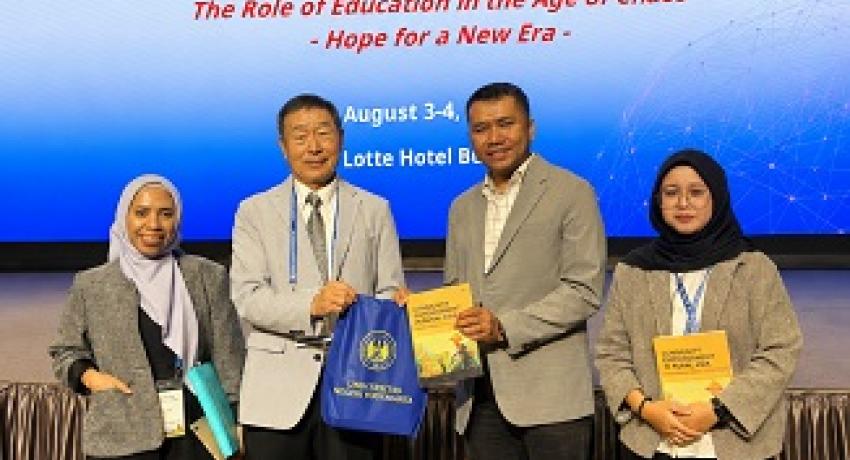

Universitas Negeri Yogyakarta (UNY) has reaffirmed its commitment to strengthening international academic networks through the participation of lecturers from the Department of Sociology Education, Faculty of Social and Political Sciences (FISIP), in the Eurasia Convention 2026, held in Busan, South Korea, from August 3 to 5, 2026. The international forum carried the theme “The Role of Education in the Age of Chaos: Hope for a New Era,” discussing the strategic role of education in responding to global challenges amid social, economic, political, and technological dynamics. The event is a regular program of the Eurasia Foundation (from Asia) and this year was held in collaboration with Busan International Foreign Studies.
UNY was represented by three lecturers from the Department of Sociology Education FISIP, namely Dr. Grendi Hendrastomo, M.M., M.A., Dr. Nur Endah Januarti, M.A., and Sasiana Gilar Apriantika, M.A. They received a direct invitation from the Eurasia Foundation (from Asia). Their participation was part of a special invitation extended to universities that had previously received grants from the foundation, in recognition of their contributions to educational collaboration and international academic exchange.
The Eurasia Lecturer Series (ELS) at UNY has a distinctive approach, combining knowledge development in the classroom with direct field experience. The program was previously held under the theme of Community Empowerment, and in the following year carried the theme of Media and Cultural Studies. These two themes align with efforts to develop critical thinking and collaboration skills, both of which are essential competencies for students in the 21st century. The topics are also relevant to the broader theme of Eurasia Convention Busan, “The Role of Education in the Age of Chaos: Hope for a New Era.”
Eurasia Convention 2026 brought together academics, researchers, and university leaders from various countries, including South Korea, Japan, Spain, Thailand, Turkey, New Zealand, Indonesia, Malaysia, Taiwan, Cambodia, Ukraine, Kazakhstan, the United States, Russia, India, and others. During the three-day event, participants took part in international seminars, panel discussions, collaboration forums, and various academic sessions focused on strengthening cross-border educational cooperation and developing learning innovations to face an era marked by uncertainty.
Beyond serving as a platform for exchanging ideas, the convention also became a strategic forum to expand international research networks and build opportunities for cooperation in education, research, academic mobility, and institutional capacity development. Issues such as higher education transformation, academic leadership, technology-based education, and the strengthening of global collaboration were among the key topics discussed. UNY’s participation in the Eurasia Convention marks an important step in strengthening the university’s position within international academic networks. The involvement of lecturers from the Department of Sociology Education FISIP UNY also reflects the university’s continued efforts to support its internationalization agenda. Through active participation in international academic forums, lecturers not only expand scholarly networks but also bring Indonesian perspectives into global discussions on the future of education.
This goal was highlighted by Dr. Nur Endah Januarti, one of UNY’s representatives at the Eurasia Convention Busan. “One of the challenges for academics is how to make critical thinking a means of integrating STEM with the social sciences and humanities, so as to produce technological skills that are both adaptive and critical,” she said.
Dr. Grendi Hendrastomo, also representing UNY, added the importance of learning context in technological development. “Gamification is one learning method that does not only focus on outcomes, but also emphasizes the learning process to create joyful learning,” he said.
Participation in the Eurasia Convention further affirms UNY’s commitment to building strategic partnerships with universities around the world. The international collaboration established through the forum is expected to have a tangible impact on improving the quality of education, developing collaborative research, and strengthening UNY’s reputation as an excellent, innovative, and globally competitive university.
Through its involvement in Eurasia Convention 2026, UNY once again demonstrated its role as a higher education institution that actively contributes to the development of education at the international level, while strengthening cooperation networks that support the university’s vision of becoming a world-class university.