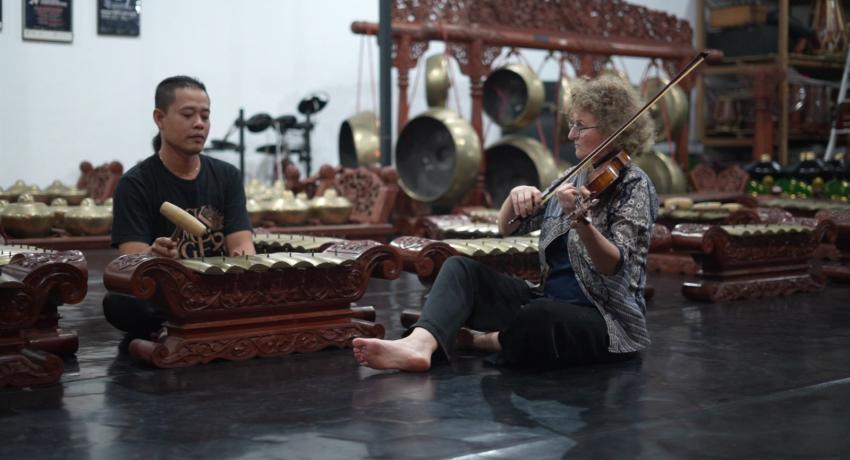



Efforts to preserve traditional arts are no longer limited to conservation, but are increasingly moving toward innovation and cross-border collaboration. Universitas Negeri Yogyakarta (UNY), in partnership with the Gayam 16 Community of Yogyakarta and the University of Poitiers, France, has introduced a hybridization of Javanese gamelan and traditional French music through the 2025 Nusantara Arts Innovation Program (Program Inovasi Seni Nusantara/PISN), supported by the Ministry of Higher Education, Science, and Technology.
Launched through the BIMA platform, the PISN program aims to encourage the development of local arts with social and economic impact, while strengthening the position of Indonesian traditional arts in the global cultural discourse. Under this initiative, UNY carries out a project entitled Digitalizing the Hybridization of Javanese Gamelan and Traditional French Music as an Adaptive Innovation in Nusantara Traditional Music.
Project leader Prof. Dr. Kun Setyaning Astuti, M.Pd., emphasized that the collaboration is designed as an equal space for cultural dialogue. “We are not merely combining two types of music, but bringing together two traditions with different cultural backgrounds to learn from one another. Javanese gamelan and traditional French music are positioned on equal footing, while preserving their respective identities and characteristics,” she said on Tuesday (23/12).
The program is implemented by a team of UNY lecturers and students from various academic levels, supported by faculty members from the Elementary Education Department of Universitas Pendidikan Indonesia (UPI) Tasikmalaya and academics from the University of Poitiers, France. The team collaborates with Gayam 16, a Yogyakarta-based music community well known for its active role in developing and performing traditional music at national and international levels.
Gayam 16 was selected as a partner based on its experience and professionalism. Originating from an arts network that grew within the Radio Geronimo Yogyakarta community, Gayam 16 has evolved into a group consistently engaged in traditional music through various collaborative formats.
Collaboration between UNY and the University of Poitiers has in fact been established since 2014. This partnership has produced several collaborative performances, including a 2019 project combining traditional French music with angklung, and a 2024 performance featuring a fusion of Javanese gamelan, traditional French music, and keroncong. These experiences provide a strong foundation for the 2025 PISN program.
The main repertoire developed in this program is a traditional French piece entitled Avant Deux Du Pere Aux Louis Dor Et De Bregeon. The work is then reinterpreted through a hybridization approach with Yogyakarta-style Javanese gamelan, using a pelog-tuned gamelan set owned by the Gayam 16 Community.
Prof. Kun explained that the creative process is carried out in stages to ensure that the original character of each musical tradition is preserved. “Traditional music has established conventions that must be respected. The real challenge is how to introduce innovation without damaging the existing structure and values,” she noted.
Putri, Partnership Coordinator and Institutional Liaison of Gayam 16, stated that the 2025 Nusantara Arts Innovation Program has brought significant benefits to her community. Through this program, Gayam 16 gains a collaborative platform to develop traditional music within a broader and more equal context alongside Universitas Negeri Yogyakarta and the University of Poitiers, France.
According to Putri, the encounter between Javanese gamelan and traditional French music serves as a shared learning process that enriches the community’s artistic perspective. Beyond the creative process, the infrastructural support provided by PISN directly contributes to improving the quality of rehearsals, production, and documentation of artistic works.
“This program not only strengthens Gayam 16’s internal capacity, but also expands our network and opens up future collaboration opportunities,” she said. Several respondents noted that through PISN, Gayam 16 has become better known among arts academics, students, and music practitioners, while also serving as an effective medium for cultural introduction through direct artistic practice and discussion.
This hybridization program aligns with the National Research Master Plan 2045 and the agenda for strengthening national culture. Through cross-country collaboration, Javanese gamelan is not only preserved as a cultural heritage, but also presented as an adaptive art form that remains relevant in a global context.