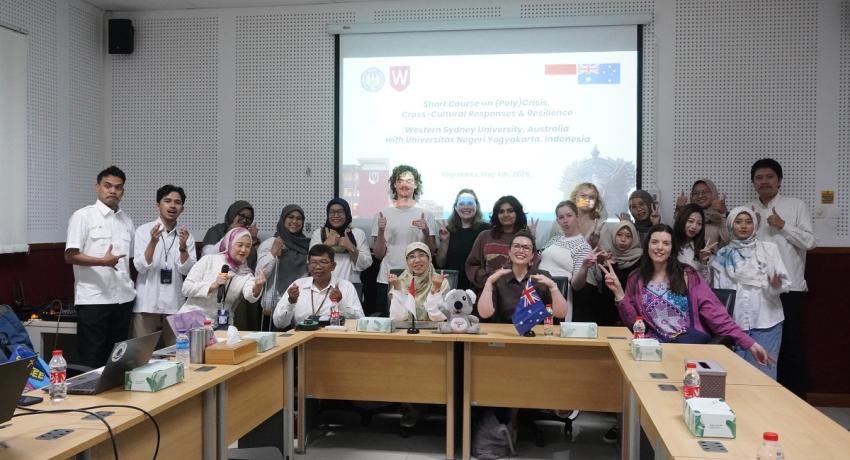



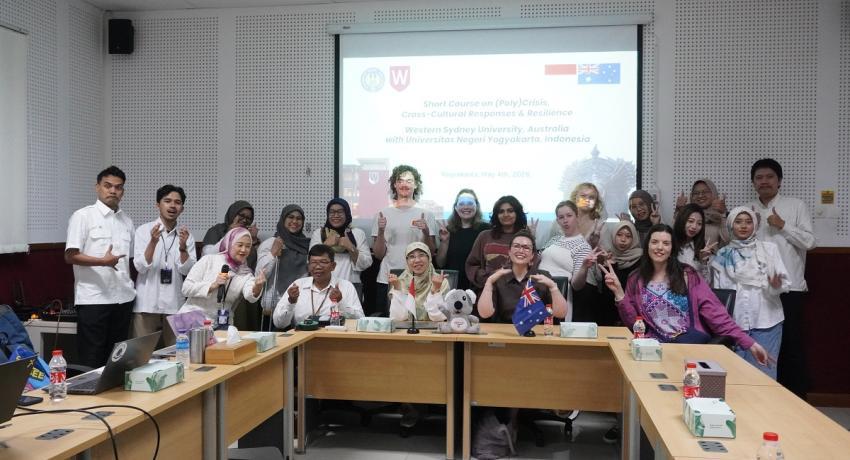
Yogyakarta – Universitas Negeri Yogyakarta (UNY) continues to strengthen its commitment to advancing the Sustainable Development Goals (SDGs) through international academic collaboration. One such initiative was the workshop titled "Global Goals, Local Realities: Rethinking the SDGs in Indonesia," which brought together students from Western Sydney University (WSU), Australia, during their academic visit to UNY.
The workshop featured Nur Azizah, Ph.D. and Dewi Eka Murniati, Ph.D. as keynote speakers, providing a platform for cross-national dialogue on the implementation of the SDGs in Indonesia, emerging global challenges, and strategies to accelerate sustainable development at both the local and national levels.
The WSU student delegation included Kaitlyn Ava Barrell, Caitlyn Marie Bremner, Jude Henry Horne, Freya Ella Pinney-Konetschnik, and Caitlin Ann Sloan. They were accompanied by Donna Marie James and Kathleen Ellen Openshaw, staff members from Western Sydney University, as part of the ongoing effort to strengthen academic cooperation between the two institutions.
During the workshop, the speakers explained that the 2030 Agenda for Sustainable Development comprises 17 Sustainable Development Goals and 169 targets covering the social, economic, and environmental dimensions of development. However, achieving these targets remains a significant global challenge. Currently, only about 17 percent of the SDG targets are on track worldwide, while the impacts of the COVID-19 pandemic, geopolitical conflicts, persistent poverty, and food insecurity have slowed—or even reversed—progress in many areas.
The Asia-Pacific region also continues to face considerable challenges in SDG implementation. According to estimates by the United Nations Economic and Social Commission for Asia and the Pacific (UN-ESCAP), the region is not expected to achieve all SDG targets until 2062, approximately 32 years beyond the 2030 Agenda deadline.
Despite these challenges, Indonesia has demonstrated encouraging progress compared to global trends. Based on data from the Ministry of National Development Planning (Bappenas) in 2024, 62 percent of the country's 224 measurable SDG indicators have already achieved their targets, while an additional 14 percent are showing positive progress toward achievement. Overall, approximately 76 percent of Indonesia's SDG indicators are advancing, although several areas still require greater attention.
Indonesia's notable achievements include reducing poverty and strengthening social protection (SDGs 1 and 8), expanding access to healthcare through the National Health Insurance (BPJS Kesehatan) program (SDG 3), improving access to education (SDG 4), strengthening gender equality policies (SDG 5), and promoting climate action and environmental conservation (SDGs 13, 14, and 15).
Nevertheless, the speakers highlighted several persistent challenges facing Indonesia's sustainable development agenda, including regional disparities, vulnerability to climate change and natural disasters, financing gaps, digital misinformation, pollution, and growing cybersecurity threats.
To accelerate progress, Indonesia continues to integrate the SDGs into national and regional development policies, including the National Medium-Term Development Plan (RPJMN), the expansion of the SDGs Desa (Village SDGs) program, and the establishment of SDG Centers at universities as hubs for research, innovation, and capacity building in sustainable development.
Through this international workshop, UNY reaffirmed its commitment to strengthening global academic partnerships while fostering the exchange of knowledge and perspectives on sustainable development across countries. The initiative contributes to SDG 4 (Quality Education) by promoting international learning, SDG 13 (Climate Action) by encouraging dialogue on environmental sustainability, and SDG 17 (Partnerships for the Goals) by enhancing collaboration between higher education institutions and expanding global engagement.