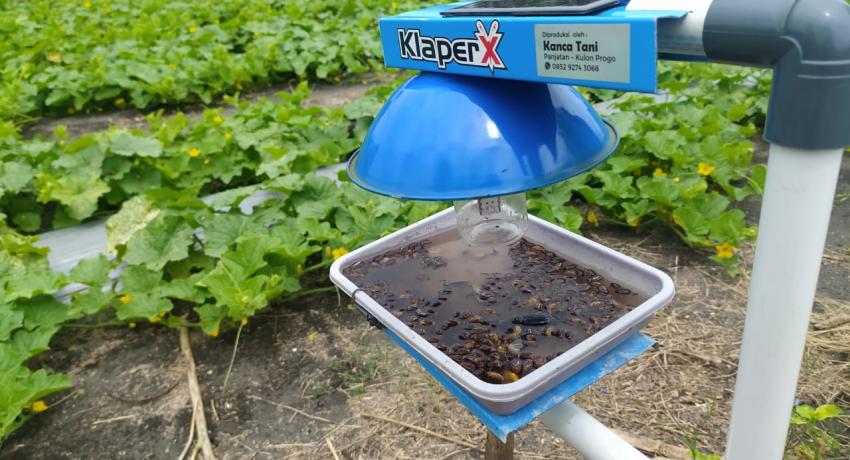



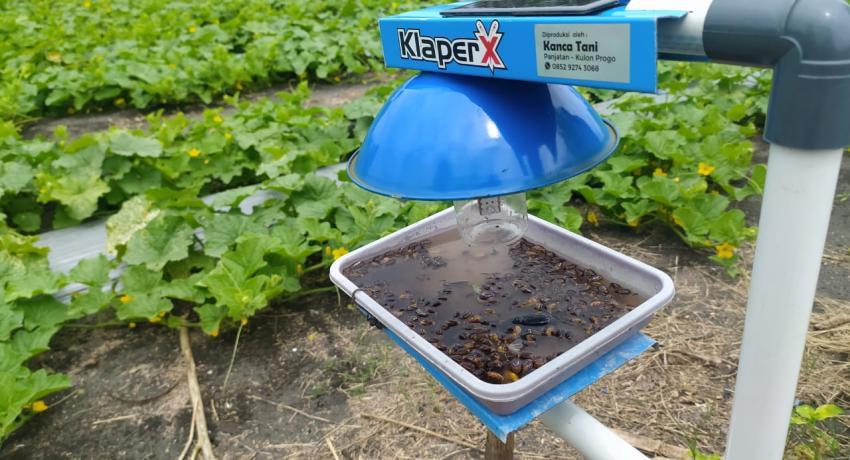
The UNY's students have developed an eco-friendly innovation to help farmers control agricultural pests effectively without relying on chemical pesticides. Through the 2025 Student Entrepreneur Development Program (P2MW) of the Ministry of Higher Education, Science, and Technology, the team—Ihsan Muchlis Amirudin, Afwa Naela Fauzia, and Rose Pita Nur Afifah—introduced the Light Trap Insect (LTI), a solar-powered automatic pest trap designed to support sustainable agriculture.
The Light Trap Insect concept emerged from concerns over the excessive use of pesticides among farmers, which negatively affects health, crop quality, and ecological balance. “We wanted to offer a solution that is simple, energy-efficient, and environmentally friendly—one that farmers can use directly,” said team leader Ihsan Muchlis Amirudin on Wednesday (12/11/25).
Powered by solar panels, the LTI operates automatically. During the day, the device stores energy from sunlight, while at night its ultraviolet lamp switches on to attract nocturnal insects such as moths and small flies that commonly damage crops. Attracted insects fall into a container filled with soapy water and become trapped. The soapy water is replaced daily to maintain effectiveness.
According to Afwa Naela Fauzia, the LTI offers significant benefits for farmers as it requires no electricity, is water-resistant, and can be reused across multiple planting seasons. “By shifting from pesticide spraying to the use of LTI, farmers can reduce operational costs while minimizing chemical residues on crops,” she explained.
Meanwhile, Rose Pita Nur Afifah noted that the Light Trap Insect has been registered for Intellectual Property Rights (IPR) covering both its product design and brand. “We hope this tool can be mass-produced so its benefits can reach more farmers, especially those who still rely on conventional methods,” she said.
The innovation has been tested in collaboration with farmer groups and the Kulon Progo Agriculture Office, yielding promising results, including a significant reduction in nocturnal pest populations and increased productivity of crops such as shallots and chilies. LTI proved particularly effective when deployed early in the planting season, as it captures adult pests before they lay eggs, enabling healthier crop growth.
Beyond boosting agricultural productivity, the innovation contributes to the Sustainable Development Goals (SDGs)—notably SDG 2 (Zero Hunger and Sustainable Agriculture) and SDG 7 (Affordable and Clean Energy). The LTI demonstrates the practical use of renewable energy to improve farmer livelihoods while protecting the environment.
Through P2MW UNY, students are nurtured not only as young innovators but also as social entrepreneurs who create economic value with tangible benefits for communities. “Student innovations like this show that environmentally friendly technology can be a future solution for Indonesian agriculture,” said Dr. Yudan Hermawan, UNY’s entrepreneurship mentor.
The Light Trap Insect stands as proof that the creative ideas of Indonesian youth can address global challenges in food security and environmental sustainability. With a spirit of collaboration and sustainability, this UNY student innovation is expected to inspire other young people to continue innovating for community welfare and the preservation of the planet.