


Sleman – Students from the Pancasila and Civic Education (PPKn) Study Program, Faculty of Social and Political Sciences (FISIP), Universitas Negeri Yogyakarta (UNY), recently organized a Project-Based Sustainable Development Goals (SDGs) initiative titled "Re-Charm Lab: Transforming Used Plastic Bottle Caps into Value-Added Accessories to Support SDG 12" at MI Muhammadiyah Al Muttaqien in Sleman.
The program represents the students' commitment to supporting SDG 12 (Responsible Consumption and Production) by promoting creative and practical approaches to plastic waste management.
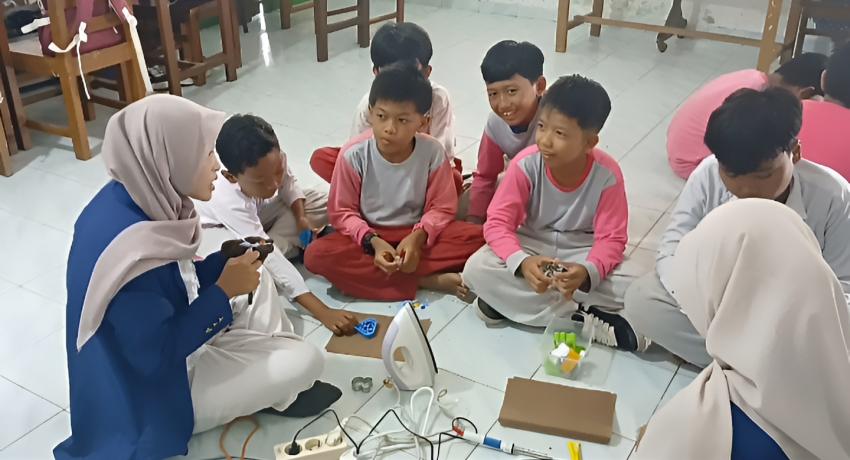
Carrying the theme "Creative Recycling for a Sustainable Environment," the initiative was inspired by the growing volume of plastic waste—particularly discarded bottle caps—which is often left unmanaged and contributes to environmental pollution. During the program, the UNY students served as facilitators and instructors, introducing fifth-grade pupils to the importance of waste management, the Sustainable Development Goals, and hands-on techniques for transforming used bottle caps into economically valuable keychains.
The educational sessions covered the environmental impacts of plastic waste, the importance of recycling, and the step-by-step process of creating creative products from recycled materials. During the practical workshop, students sorted bottle caps by color, cleaned them, cut them into small pieces, and then heated and molded the plastic into various accessory designs before attaching keychain rings. Through this process, participants not only learned about environmental conservation but also gained an introduction to entrepreneurship by turning waste materials into products with commercial value.
According to one of the program organizers, the initiative was designed to foster environmental awareness from an early age. Through simple yet meaningful activities, students learned that materials often regarded as waste can be transformed into attractive and useful products. Participants showed great enthusiasm throughout the workshop, while the school expressed its appreciation for the program's ability to combine environmental education with enjoyable and interactive learning experiences.
The Re-Charm Lab program was implemented by Group 8 of the PPKn Study Program, consisting of Uni Afwatul Khasanah, Intan Fitri Ardinasari, Jauzyiah Noveriska Nurhusna, Dian Permata Sari, Machiko Maia Purwanto Putri, and Novita Dewianti, under the supervision of Eko Swi Darmawan, M.Pd.
Through this initiative, the students encouraged elementary school pupils to become more environmentally responsible while introducing the principles of the circular economy by demonstrating how plastic waste can be converted into creative products with economic value. In addition to advancing SDG 12 (Responsible Consumption and Production), the program also contributes to SDG 13 (Climate Action) by promoting efforts to reduce plastic waste and encourage more sustainable environmental practices.