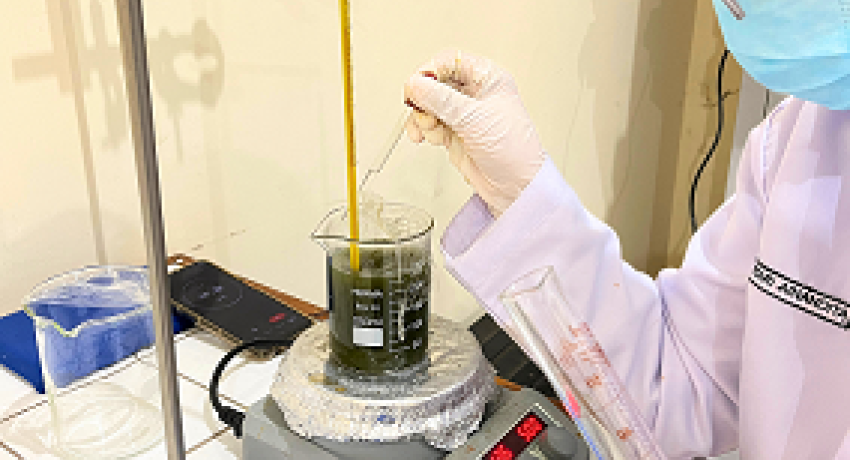



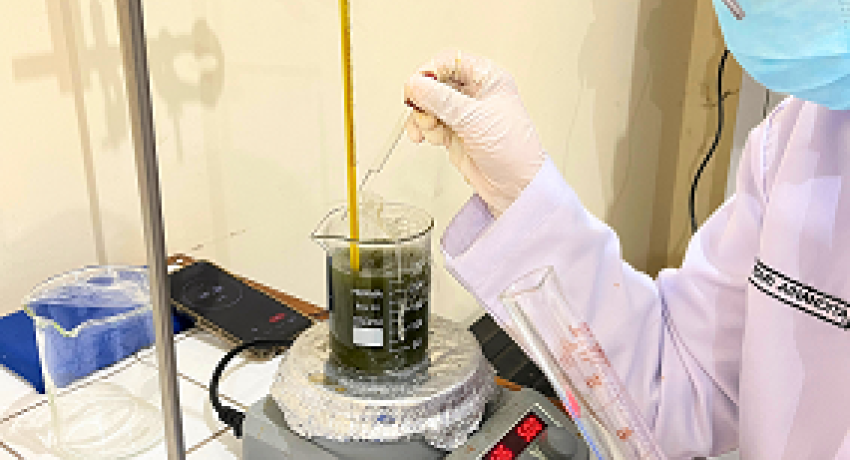
Five students from the Faculty of Mathematics and Natural Sciences (FMIPA) at Universitas Negeri Yogyakarta (UNY) have developed an environmentally friendly photocatalyst based on Cu₂O/CuO@TiO₂ nanocomposites by utilizing discarded copper cables and lime peels. The innovation was carried out under the Student Creativity Program in Exact Research (PKM-RE) as an effort to provide a sustainable solution to pollution caused by textile and batik industry wastewater.
The PKM-RE team is led by Ria Amelia (Physics, Class of 2023), with members Martin Imanuel Panjaitan (Physics, 2024), Sekar Samuso Jati (Physics, 2023), Nandari Ainandita (Chemistry, 2023), and Isnaini Laila Azizah (Biology, 2023). The research is supervised by Riza Ariyani Nur Khasanah, S.Pd., M.Sc., Ph.D., a lecturer in the Department of Physics, FMIPA UNY.
Through their research titled "Engineering Cu₂O/CuO@TiO₂ Nanocomposites from Copper Cable Waste Using Lime Peel Extract for Batik Dye Waste Photodegradation," the team uses discarded copper cables as a source of copper ions and lime peel extract as a natural reducing agent during the synthesis of the photocatalytic material.
The novelty of the research lies in its application of a green synthesis approach by simultaneously utilizing two types of waste: electronic waste and organic waste. Lime peels collected from food and beverage vendors at the UNY Foodcourt contain polyphenol compounds that serve as natural reducing and stabilizing agents in the formation of Cu₂O/CuO. Meanwhile, discarded copper cables are transformed into valuable raw materials for producing photocatalytic nanocomposites.
The developed photocatalyst is designed to exhibit high activity under visible light, enabling it to degrade methyl orange, a synthetic dye commonly found in textile and batik wastewater. Through the photodegradation process, the dye is broken down into simpler compounds that are less harmful to the environment. In addition to offering a sustainable solution for industrial dye pollution, the innovation also promotes the principles of the circular economy by converting waste into high-value functional materials. This approach demonstrates that materials often regarded as waste can be transformed into innovative products that contribute to environmental sustainability.
According to team leader Ria Amelia, the research is expected to become an alternative environmentally friendly wastewater treatment technology while raising public awareness of the potential of waste as a valuable resource with both economic and environmental benefits.
Updates on the research and the team's activities can be followed through their Instagram account, @pkmre_cucitrox, which documents the research process from waste collection and material synthesis to photocatalyst testing.