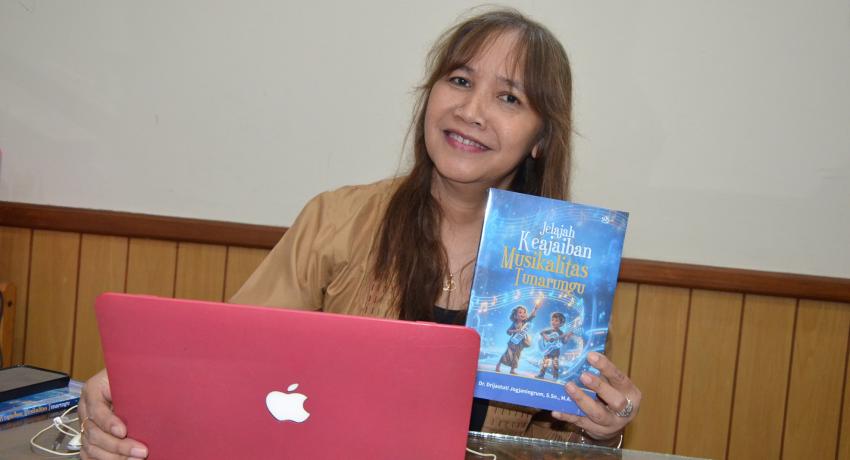



The perception that deaf individuals cannot enjoy or perform music is still commonly found in society. The assumption that music can only be accessed through hearing has long become a stigma that limits the expressive space of the deaf community. Through her latest academic work, Dr. Drijastuti Jogjaningrum, M.A., a lecturer in the Music Education Study Program at the Faculty of Languages, Arts, and Culture (FBSB), Universitas Negeri Yogyakarta (UNY), seeks to challenge this perception through her book entitled Exploring the Wonders of Deaf Musicality.
Published by UNY Press in February 2026, the book presents a new perspective on the relationship between music and deaf individuals. Beyond discussing music theory, the work explores the history of deaf education both globally and in Indonesia, the development of sign language, and musical practices that can be accessed through multisensory experiences.
According to Drijastuti, society still frequently questions the ability of deaf individuals to enjoy music. Questions such as “Can deaf people really play music?” or even cynical remarks like “How can a deaf person play music?” remain part of the social realities faced by the deaf community. Through this book, she aims to demonstrate that music does not exist solely through sound, but can also be experienced through visual elements, vibrations, and body movements.
One of the central ideas highlighted in the book is that music is not merely an auditory phenomenon, but a multimodal experience that can be seen and felt. For deaf individuals, musical experiences may emerge through rhythms perceived by the body, vibrations sensed through touch, and visual expressions conveyed through sign language and movement.
“There is still a stigma that deaf individuals cannot enjoy music because they cannot hear sound. In fact, musicality is not only experienced through sound, but also through vibrations, visuals, and bodily experiences. I wrote this book to open perspectives that music is a space of expression that can also be accessed by deaf individuals,” said Drijastuti on Wednesday (13/5/26).
Comprehensively, the book discusses how deaf individuals possess unique forms of musical identity. Drijastuti explains that musical experiences can be accessed through three main dimensions: tactile sensory experiences to feel musical vibrations, visual sensory experiences to observe rhythmic patterns and musical expressions, and kinesthetic sensory experiences that allow music to be experienced through body movement. This multisensory approach demonstrates that hearing limitations are not barriers to experiencing the beauty of music.
Beyond conceptual discussions, the book also offers various practical applications of deaf musicality in therapy, education, socio-cultural activities, and technological development. In education, for instance, multisensory musical approaches are considered an alternative for creating more inclusive learning environments for deaf students. In technology, the development of vibration- and visual-based devices is seen as opening broader access to music for the deaf community.
Through this book, Drijastuti hopes society will develop a new perspective regarding the rights of deaf individuals to access equal musical experiences. Furthermore, the work is expected to serve as a reference for special education schools, educational institutions, researchers, musicians, and technology developers in creating a more inclusive musical ecosystem.
“Music should not always be understood solely as an auditory experience. Deaf individuals have their own unique forms of musicality through vibrations, visual rhythms, and expressive movement. I hope this book can become a bridge of understanding as well as a reference for more inclusive arts education,” she stated.
The publication of Exploring the Wonders of Deaf Musicality also reinforces UNY’s commitment to advancing socially impactful knowledge, particularly in strengthening inclusive education and equal access for all members of society. In line with the Sustainable Development Goals, this work contributes to SDG 4 (Quality Education) and SDG 10 (Reduced Inequalities) through the promotion of inclusive and equitable access to arts education.