

Five students from Universitas Negeri Yogyakarta (UNY) initiated a literacy-based community service innovation to address issues related to children’s character education in Trimulyo Subdistrict, Genuk District, Semarang City. Through the Student Creativity Program in Community Service (PKM-PM) titled Pelita Aksara Pelangi Anak, they seek to build children’s character through a creative and enjoyable literary approach.
The student team consists of Mutiara Firdaus as team leader, Bagaskara Putra Utama and Bastian Agrinitus from the Indonesian Literature Study Program, as well as Fauzan Nur Alamsyah and Sabina Sinkhu Fisicella from the Educational Technology Study Program. The five students developed a collaborative program that combines children’s literacy, character education, and family involvement as a foundation for social change.
Team leader Mutiara Firdaus explained that the program was born from concerns over the social conditions of children in Trimulyo. Based on observations conducted with their community partner, a number of elementary school-aged children were considered to have begun showing negative behaviors, such as the use of harsh language and a tendency to normalize violence due to peer and environmental influences. This condition was further worsened by limited parental supervision and the lack of positive spaces for children to express themselves.
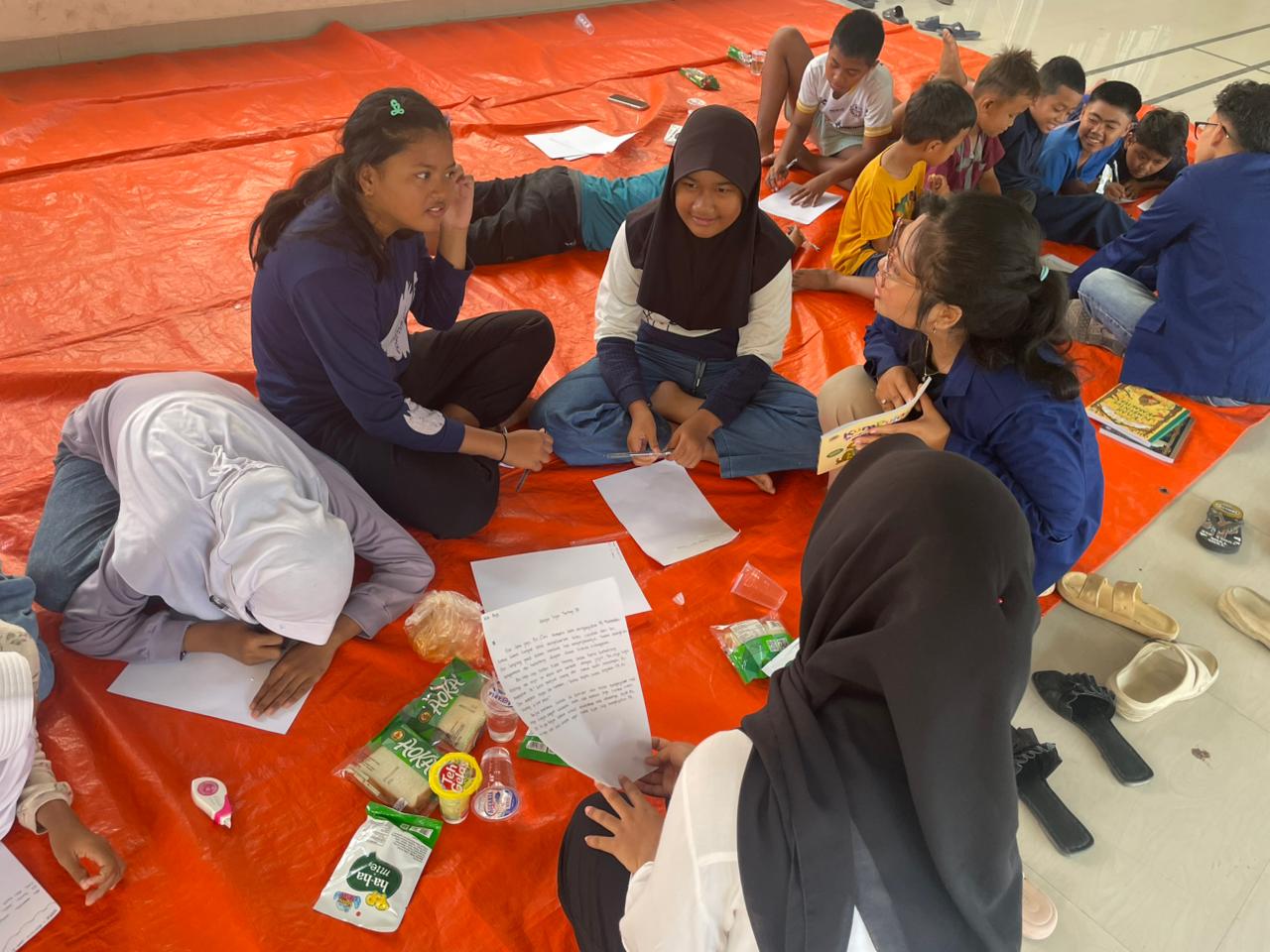
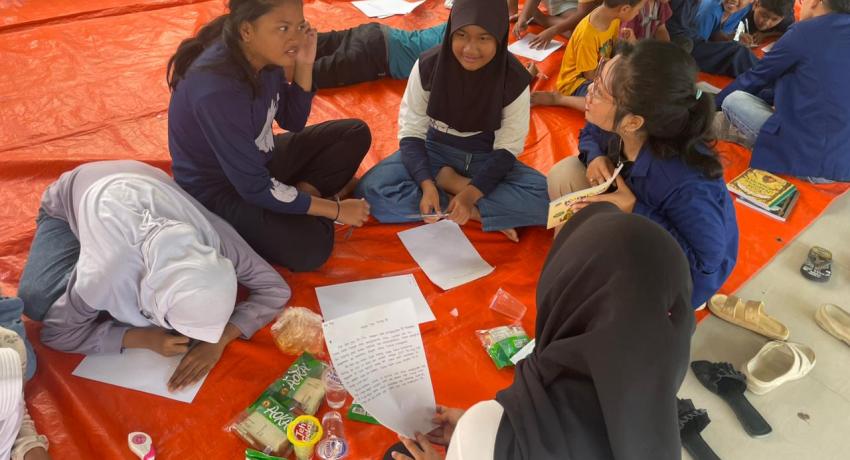
Through Pelita Aksara Pelangi Anak, the UNY students offer a different approach. Rather than using conventional guidance methods, the program uses children’s literature as a medium for character education through storytelling, reading activities, creative writing, and moral discussions presented in an interactive format. The program does not only target children, but also involves parents through parenting training to strengthen family relationships and improve supervision of children’s growth and development.
The program is designed in five main stages: Pelita Harapan as the preparation stage, Pelita Cendekia for program introduction, Pelita Jiwa as the initial evaluation of children’s abilities, Pelita Bangsa as the core activity, and Pelita Aksara as the final evaluation. During the core stage, children will be guided to create literary works and present their stories to their parents, while parents take part in a PARENTing session, Pahami, Asah, Respons, Empati, Nyatakan, Tumbuhkan, aimed at strengthening character-based parenting practices.
Bastian Agrinitus, one of the team members, said literature was chosen because it is considered effective in instilling moral values without sounding didactic. Through stories, children are encouraged to understand values such as honesty, empathy, courage, and tolerance in ways that are close to their daily lives. At the same time, creative activities such as writing and storytelling are expected to provide a positive space for children to express themselves.
In addition to building children’s character, the program is also expected to strengthen the non-formal education ecosystem within the community. The Trimulyo youth organization, Karang Taruna, is involved as the main partner in coordinating participants, assisting program activities, and supporting the program’s sustainability after the PKM has been completed. The student team has also prepared a partner guidebook and social media channels as educational and documentation platforms, allowing the program to be replicated in other areas.
Pelita Aksara Pelangi Anak is not only a concrete contribution by UNY students in addressing education-based social issues, but also supports the achievement of the Sustainable Development Goals (SDGs). The program aligns with SDG 4 on Quality Education through the strengthening of literacy and literature-based character education for children, SDG 16 on Peace, Justice, and Strong Institutions through efforts to prevent violent behavior and negative environmental influences from an early age, and SDG 17 on Partnerships for the Goals through collaboration among students, parents, youth organizations, schools, and the community in creating a sustainable environment that supports children’s development.
Through this creative and collaborative approach, UNY students show that literature is not only a medium for language learning, but can also serve as a “light” that guides children to grow into a generation with strong character, empathy, and literacy skills for the future.