


The long-standing problem of open waste burning in Kecemen Village, Manisrenggo District, Klaten Regency, has found a practical solution through an innovation developed by students of Universitas Negeri Yogyakarta (UNY). As part of the 2026 Off-Campus Learning Program (PLK UNY Mengabdi), a team of students designed and donated a Low-Smoke Waste Incinerator, an appropriate technology that enables the community to manage household waste in a safer, healthier, and more environmentally friendly manner.
The innovation was officially handed over to the local community recently as one of the flagship projects of PLK UNY Mengabdi 2026. The incinerator was developed in response to the common practice of open waste burning, which has long contributed to air pollution and posed health risks, particularly for children and older adults.
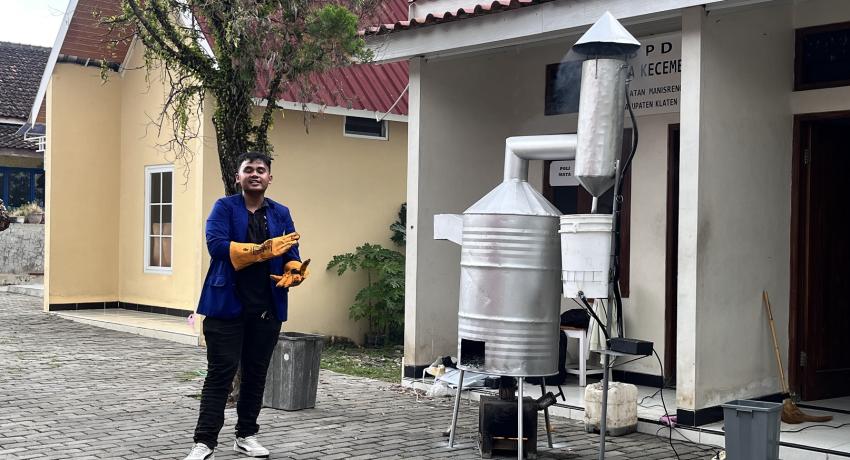
Muhamad Fadhil Nugroho, leader of the PLK team in Kecemen Village, explained that the incinerator operates using a combustion system fueled by used cooking oil. The heat generated produces steam that flows through pipes, intensifying the fire inside the combustion chamber without the need for an electric blower. The higher combustion temperature allows waste to burn more completely, significantly reducing the amount of smoke produced compared to conventional open burning.
The system also includes a second drum that functions as a smoke filtration chamber. Inside this chamber, water condensation helps capture combustion particles, resulting in cleaner emissions. All components are made from affordable and widely available materials, allowing local communities to replicate the technology independently if needed.
Development of the incinerator began in early April 2026. After completing the design and construction process, the PLK team organized a public demonstration and educational session on May 14, 2026. During the event, students explained the operating principles of the incinerator, its environmental and health benefits, and safe operating procedures. Community members showed great enthusiasm, asking questions about the construction process, burning capacity, and durability of the equipment.
A follow-up training session was held on May 30, 2026, during which residents were given the opportunity to operate the incinerator themselves under the guidance of the student team. This hands-on approach ensured that community members understood both the operation and maintenance of the equipment, enabling its sustainable use after the completion of the PLK program.
At the conclusion of the project, the PLK team officially handed over the Low-Smoke Waste Incinerator to the Kecemen Village Government for use as a shared community facility. Village officials welcomed the innovation and expressed hope that it would support waste management efforts in Neighborhood Associations (RW) 07 and 09 while encouraging greater public awareness of environmental protection.
"We realize that waste management challenges cannot be solved overnight. However, we hope this simple innovation can serve as an initial step toward changing community behavior in managing waste in a healthier and more environmentally responsible way. If used consistently, its benefits will be directly felt by the community," said Muhamad Fadhil Nugroho.
The Low-Smoke Waste Incinerator is part of the Infrastructure and Environment pillar of the PLK UNY Mengabdi 2026 program in Kecemen Village. The initiative supports the overarching theme of "Empowering the Local Potential of Kecemen Village to Build an Independent and Sustainable Community through Appropriate Technological Innovation, Enhanced Literacy, Creative Economy Development, and Environmental Health."
Through this innovation, UNY students have not only provided a practical solution to a pressing environmental issue but have also encouraged more responsible waste management practices within the community. The project is expected to inspire other villages to adopt similar technologies in creating cleaner, healthier, and more sustainable living environments.